Analysts
Analysts use Media Monitor to hear what company leaders say about their plans — and to catch the details that never make the press release.
- Follow the people, not just the company. People pages track every executive’s appearances.
- Pull out the plans. Ask lists every forward-looking statement in an episode, with timestamps, in a few minutes.
- Never miss an interview. Alerts flag new appearances and mentions of product names.
- Keep a record. Dated quotes show when a plan first came up, and when it changed.
Case study: A month of OpenAI interviews
OpenAI’s DevDay on Sept. 29 came with 25 announcements. In the month around it, 12 OpenAI employees gave interviews on podcasts and CNBC, from CEO Sam Altman and CFO Sarah Friar to the product leads behind ChatGPT and Codex.
An analyst covering AI wants to know: what did they say about OpenAI’s plans that the company hasn’t published?
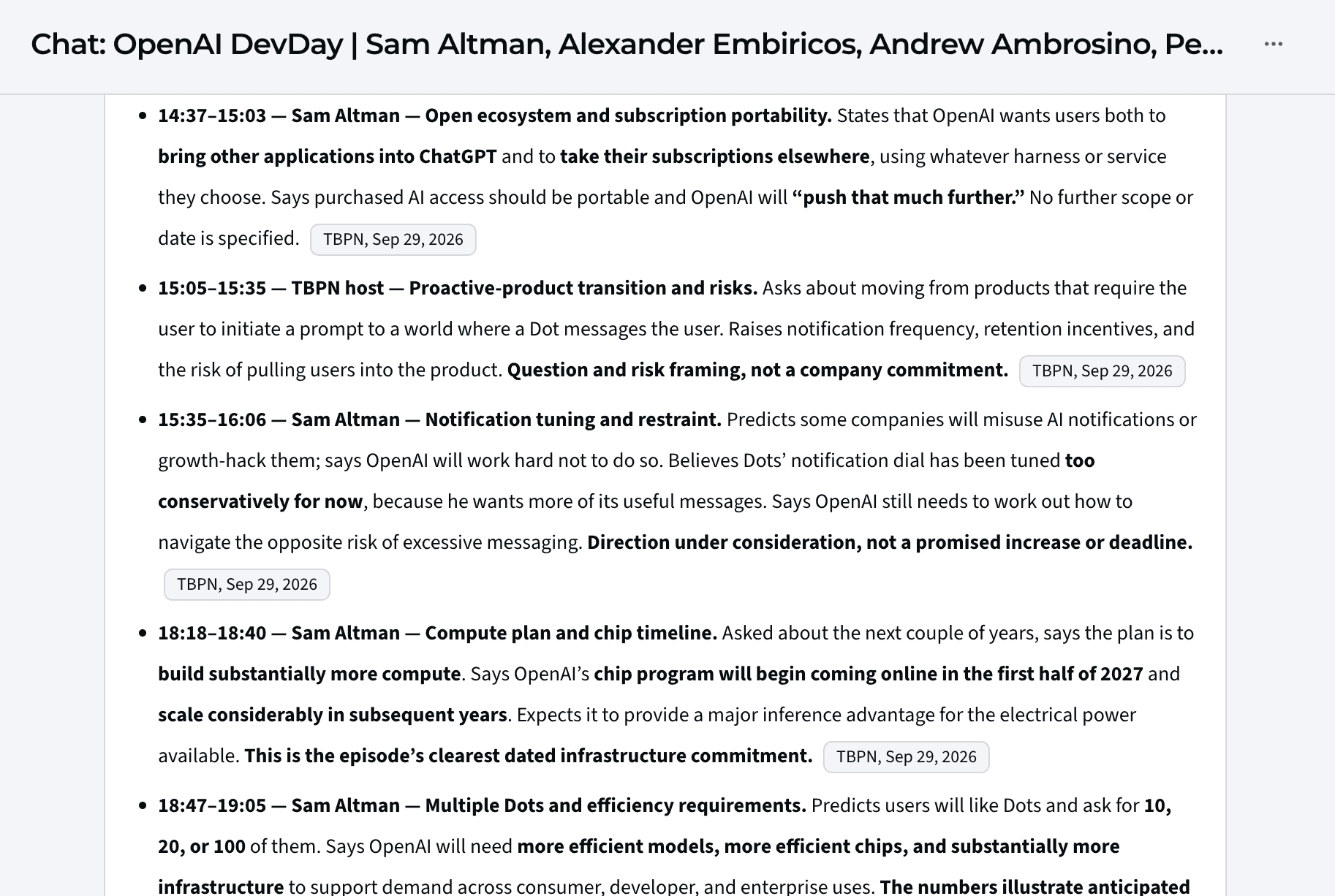
What an analyst would have heard
- A revenue share for partners. ChatGPT head Tibo Sottiaux said makers of popular plugins, and Sign in with ChatGPT partners, will get a cut. Lenny’s Podcast, 12:59 It wasn’t in the keynote.
- A pricier API option. API product lead Nikunj Handa said a 12-hour prompt cache is in preview with one customer and will roll out at a higher price. Latent Space, 33:30
- A later chip timeline. Altman said OpenAI’s own chips come online in the first half of 2027. TBPN, 18:18 OpenAI’s August post said deployment would start by the end of 2026.
- A security scramble. Friar said OpenAI moved 25% of its engineers off production work to fix what its own Astra model found when pointed at the company’s systems.
- A hint, eight days early. On DevDay, Codex’s Alexander Embiricos said interfaces generated on the fly were “coming out soon.” TBPN, 37:04 OpenAI shipped Intelligent UI on Oct. 7.
“For one of our users, we just launched a much longer cache window, so we have a 12-hour caching guarantee…”
“To what extent should UI be generated just in time for the user? … There’s like some cool stuff coming out soon around that.”
Case study: Prediction markets and the sportsbook stocks
Kalshi came up in 180 episodes between Sept. 1 and Oct. 8.
An analyst covering DraftKings and Flutter, which owns FanDuel, wants to know: are prediction markets taking sportsbook customers, or finding new ones?
Search narrowed the 180 to eight episodes that dug in. Ask read them for what matters to the stocks.
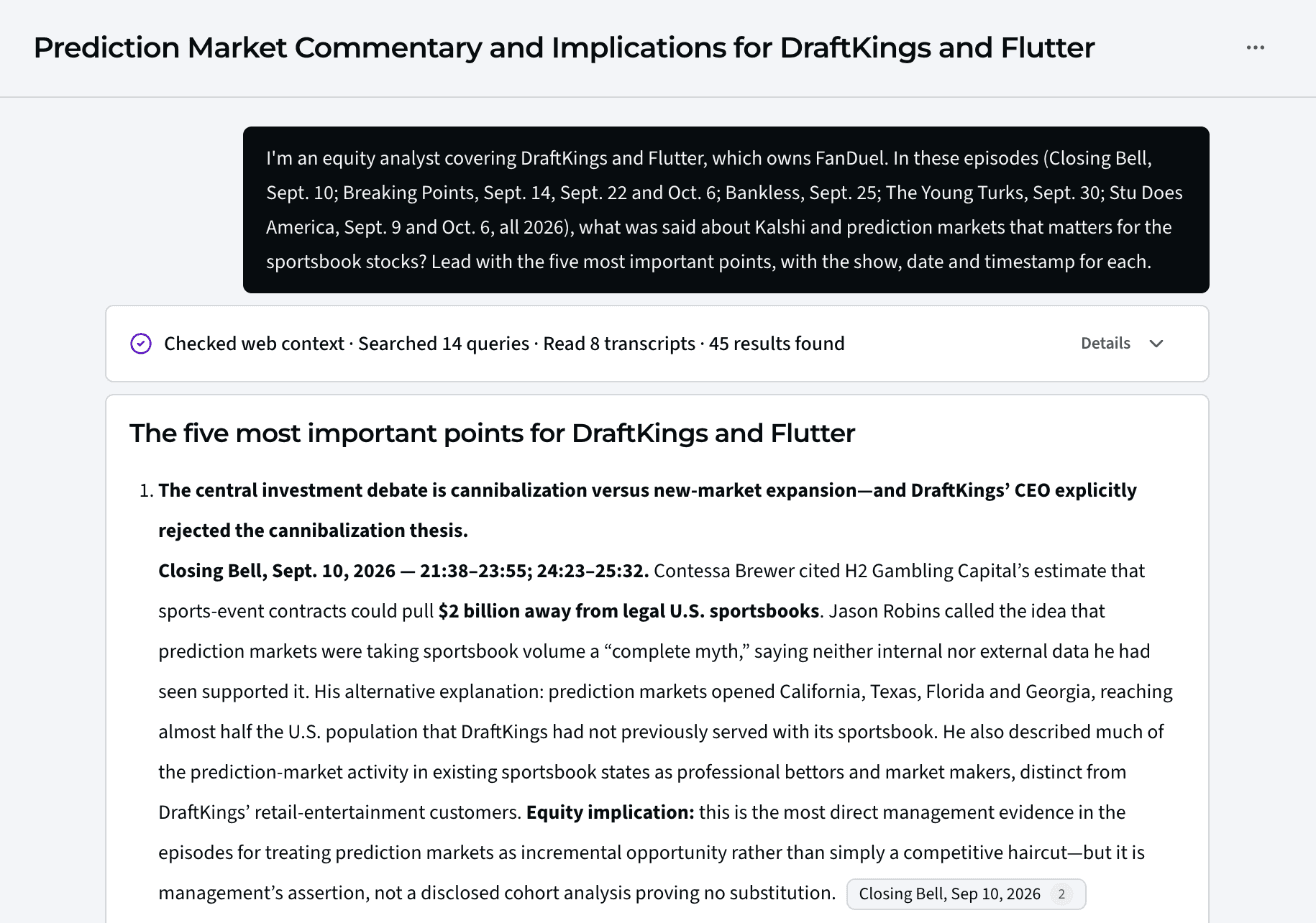
What the sportsbook analyst would have heard
- The CEO says it’s new money. When CNBC’s Contessa Brewer cited an estimate that prediction markets could pull $2 billion from legal sportsbooks, Closing Bell, 21:48 DraftKings CEO Jason Robins called the idea “a complete myth.” Closing Bell, 22:09 They reach almost half the country, he said, where DraftKings had no sportsbook. Closing Bell, 22:38
- Court rulings move the stock. When Nevada won a Ninth Circuit ruling that it can enforce its gambling laws against Kalshi, Brewer noted, DraftKings stock rose. Closing Bell, 24:01 On Sept. 30, The Young Turks reported that another appeals court had ruled the same way in Kalshi’s Ohio and Tennessee cases. The Young Turks, 1:48:48
- FanDuel may be on both sides. Citing a Barron’s scoop, Breaking Points’ Saagar Enjeti said FanDuel is the market maker behind many Kalshi parlays. Breaking Points, 28:21 A week later, he said FanDuel and DraftKings take the other side of them. Breaking Points, 31:39
- Read the volume numbers carefully. Bankless went through allegations of wash trading in Kalshi’s crypto contracts, and how prediction-market volume gets counted. Bankless, 42:23 Kalshi has said the CFTC isn’t investigating it. Bankless, 47:05
- The backlash cuts both ways. Breaking Points told of a gambler who banned himself from FanDuel and DraftKings, then lost more than $25,000 on Kalshi. Breaking Points, 45:59 Two weeks earlier, the same show went after DraftKings’ own promotions. Breaking Points, 25:20
“I think the notion that it’s pulling volume from sportsbooks is a complete myth.”
“When Nevada gets a win in the Ninth Circuit saying that it can enforce its state gambling laws against Kalshi, with whom CNBC has a commercial relationship, DraftKings stock pops.”
Ask’s bottom line: The coverage points three ways — sportsbook customers moving to Kalshi, new customers where sportsbooks can’t go, and sportsbooks earning as Kalshi’s market makers — and none of it has the numbers to say which wins.