Researchers and think tanks
Researchers and think tanks use Media Monitor to unearth broader learnings from podcasts — and to back every finding with the transcript.
- Count what’s said. Search every transcript by word, date and show, and see how many episodes match.
- Read across the spectrum. Ask compares how different shows discuss a topic, with citations to the minute.
- Group your sources. Tag shows — conservative, business, tech — and filter by tag.
- Cite every finding. Each quote links to its transcript, with the speaker and the timestamp.
Case study: The affordability election
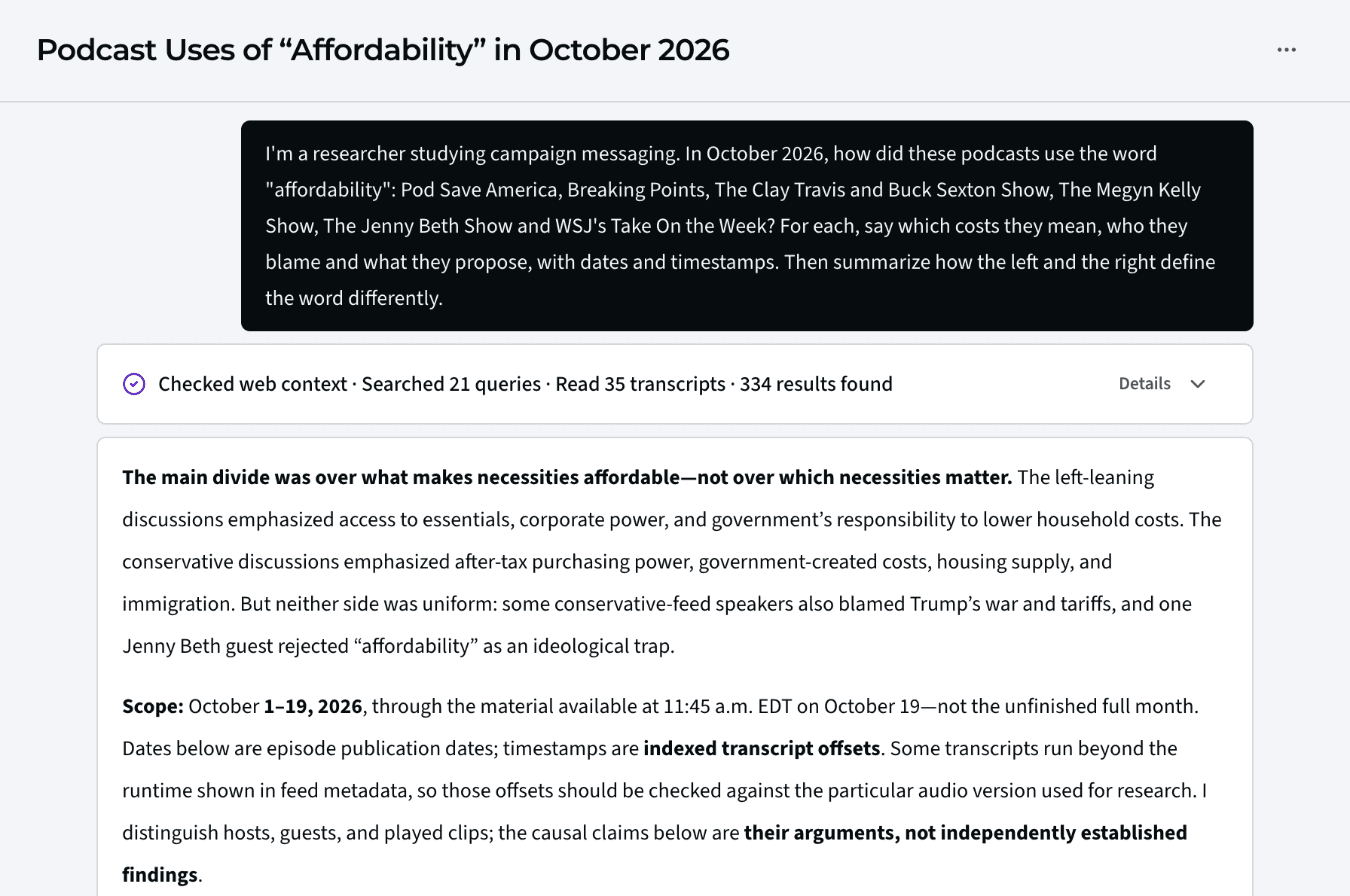
Two weeks before the midterms, both parties say the election is about affordability. In the first 18 days of October, the word came up in 597 episodes, more than in all of September.
A think tank studying campaign messaging wants to know: when podcasts on the left and the right say “affordability,” do they mean the same thing?
What the researcher would have found
- The same costs, different causes. Both sides talked about housing, gas, groceries and health care. Ask found the split was over what makes them affordable, not which ones matter.
- On the left, a basic need. Amanda Janoo, the Democrat running for governor of Vermont, defined it as “basic needs, health care, housing, food, energy,” Breaking Points, 42:54 and said her opponent, Gov. Phil Scott, treats it as tax cuts.
- On the right, what you can buy. A guest on The Jenny Beth Show said affordability means “to everyone according to his needs,” a communist idea, where capitalism says “according to his means.” The Jenny Beth Show, 48:24
- The right isn’t united on blame. Ryan Girdusky, a conservative host, said Republicans had made affordability worse, “namely the war in Iran,” along with shifting tariffs. It’s a Numbers Game, 4:01
- To business shows, it’s everything. Morgan Stanley Wealth Management’s Monica Guerra said it might mean a data center, California gas prices or grandkids who can’t buy a house. WSJ’s Take On the Week, 18:25
“When the basic needs are unaffordable, that’s why you need government intervention, because you have a scenario where they can charge as much as they want until people reach their breaking point.”
“Affordability is a very misleading term … That’s communist motto. But everybody, including Trump, picked it up and started to use it.”
The coding scheme: Ask suggested coding each use as about necessities or purchasing power, then separately for who’s blamed, what’s proposed and whether the speaker is endorsing the frame or attacking it.
Case study: The data center backlash
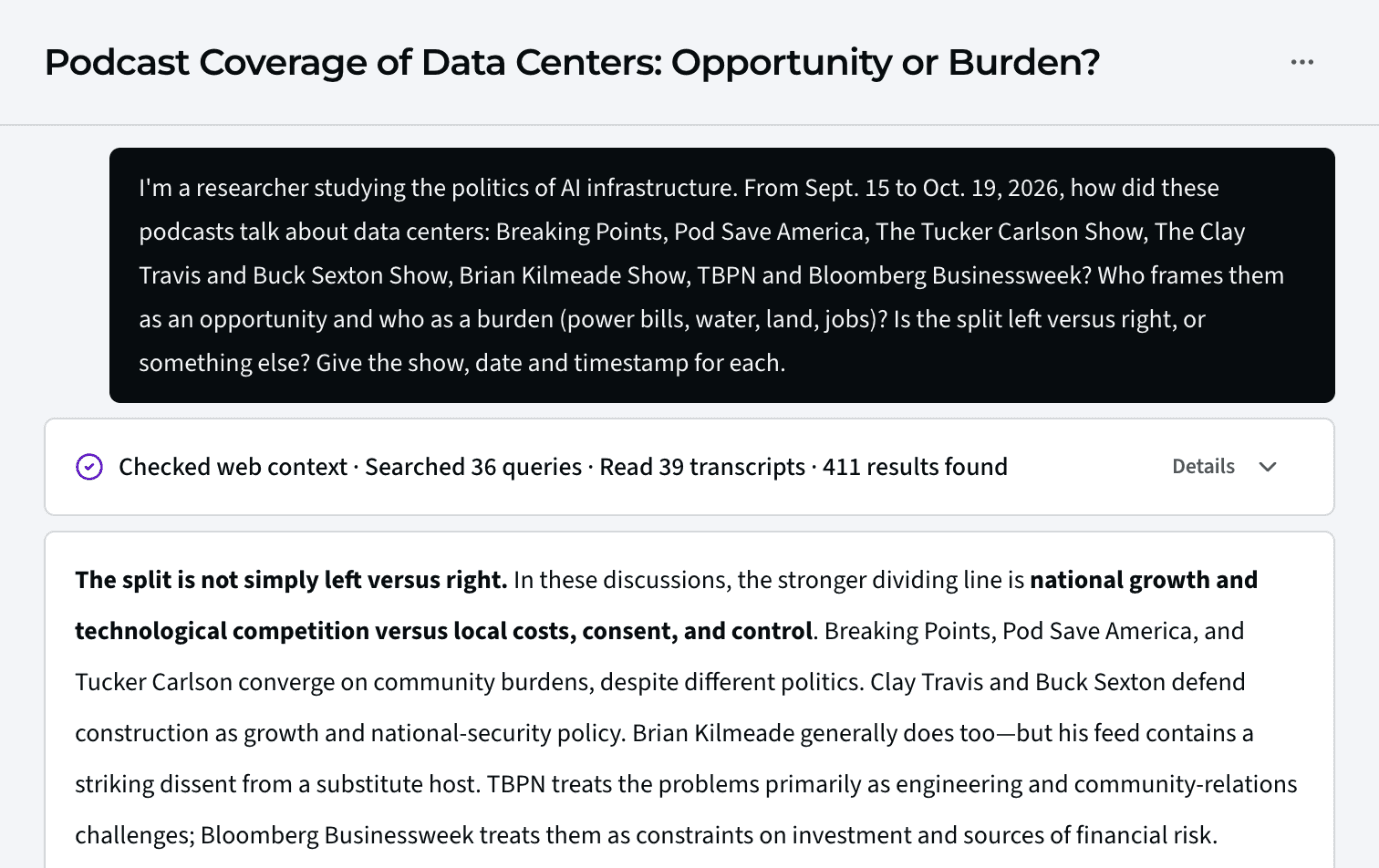
Data centers came up in 981 episodes in September, twice as many as affordability. About one in five also mentioned electricity.
A think tank studying the politics of AI infrastructure wants to know: is the backlash coming from the left or the right?
What the researcher would have found
- It isn’t left versus right. Ask found the divide runs between national growth and local costs and consent, with Breaking Points, Pod Save America and Tucker Carlson on the same side. “It’s not particularly partisan,” Sarah Longwell said, pointing to “no data center” signs in rural Pennsylvania. Pod Save America, 1:14:07
- Candidates are running on it. Will Lawrence, running for Congress in Michigan, said Trump voters back him because they’ve seen him “fighting back against data centers.” Breaking Points, 1:14:31
- Even pro-building shows split. Ask found Clay Travis and Buck Sexton defend data centers as growth and national security. But guest-hosting Brian Kilmeade’s show, Mary Walter called them “a blight” and “a deal with the devil.” Brian Kilmeade Show, 49:38
- The White House heard it. JD Vance said “99% of the backlash” comes where data centers raise utility bills. Brian Kilmeade Show, 1:31:43 About a dozen episodes played the line within two days.
“I really do believe that our politics are more about top versus bottom than left versus right.”
“They’re just a blight. … It’s a deal with the devil.”
The finding: Party predicts whom speakers blame, Ask concluded, not whether they see the burden. The real argument is whether payments, technology and local rules can make the bargain acceptable.